

Master of My Fate: Teaching Resilience When Students Want to Quit
The poem Mandela recited in prison, and why it belongs on a classroom wall.
'I am the master of my fate, I am the captain of my soul.' Henley wrote it from a hospital bed; Mandela recited it in prison. For students facing setbacks, few messages carry more proven power — here is how to bring that resilience into your classroom.
Words tested by real adversity
William Ernest Henley wrote 'Invictus' from a hospital bed while facing the amputation of a leg, refusing to let his circumstances break his spirit. Decades later, Nelson Mandela recited it to fellow prisoners on Robben Island to keep their hope alive through years of confinement. These are not comfortable words written in comfortable times — they were forged in genuine hardship, and that is exactly what gives them their weight on a wall today.
For students, that history matters enormously. I am the master of my fate, I am the captain of my soul is not just a motivational slogan to be glanced at and ignored; it is a survivor's creed with real lives behind it. On a classroom wall, it tells young people that even when they cannot control what happens to them — a bad grade, a hard home life, a failure they did not see coming — they can always choose their response. That single idea is the seed of resilience.
Telling students the story behind the poem makes it land even harder. When a young person learns that these words helped a man endure prison and another endure the loss of a limb, the lines stop being decoration and start being proof that the human spirit can hold firm under almost anything. Printed on demand and shipped worldwide by Redbubble, that proof can hang wherever a student needs it most.
Shop the poster →
For the student who wants to give up
Every teacher knows the student who shuts down at the first real obstacle — the one who decides they 'can't' before they have truly tried, who treats a single setback as a final verdict. Resilience is a skill, not a personality trait, and like any skill it grows with the right reinforcement over time. A wall that quietly insists you are in charge of your own effort helps build that muscle across a whole semester, one glance at a time.
It works especially well in the spaces where students most often feel defeated: a tutoring room, a testing area, a counselor's office where the toughest conversations happen. When a young person is convinced they have no power over their situation, a reminder that they are the captain of their soul can be the small spark that gets them to try one more time — and trying one more time is often all it takes to break a spell of discouragement.
Resilience built this way compounds. Each time a student pushes through a hard moment instead of quitting, they gather a little more evidence that they can. A poster will not do that work alone, but it is a steady, patient ally — always there, always saying the same brave thing on the day a student is closest to giving up.
Shop the poster →Resilience is a skill you can teach
It helps to remember that resilience is not something students either have or lack — it is something they build, the same way they build any other skill. The student who seems naturally tough usually got that way through repeated practice at recovering from small failures, often with someone in their corner reminding them that a stumble is not the same as a fall. A poster cannot replace that someone, but it can reinforce the message every day in between.
You can teach the skill directly. Normalize struggle by talking openly about your own setbacks. Reframe failure out loud — 'that didn't work, so now we know more than we did' — until students start doing it on their own. Celebrate the comeback as loudly as the win. A wall that champions resilience gives all of that teaching a visible anchor, a place students can look to that says the same thing you keep saying: the response is always yours to choose.
Pair it with the phoenix
Words and images reinforce each other in ways that neither manages alone. Pairing Master of My Fate with the Fiery Phoenix Rising design — the mythic bird that burns to ashes and rises again — gives students both a creed and a symbol of comeback. Together they turn a corner of the room into a resilience station: a place that says, plainly, setbacks are temporary and rising again is always possible.
For older students especially, the combination resonates deeply. The phoenix is a symbol they already love from stories, films and tattoo art; the Henley lines give that beloved image words and a history. The pairing makes resilience feel less like a lecture handed down by an adult and more like an identity a student can choose for themselves — and an identity, unlike a lecture, tends to stick.
Because both designs are printed on demand and shipped worldwide by Redbubble, it is easy to build that resilience corner in whatever sizes suit your space. A bold phoenix above the desk and Henley's creed beside it can quietly anchor an entire room in the idea that falling down is never the end of the story.
Shop the poster →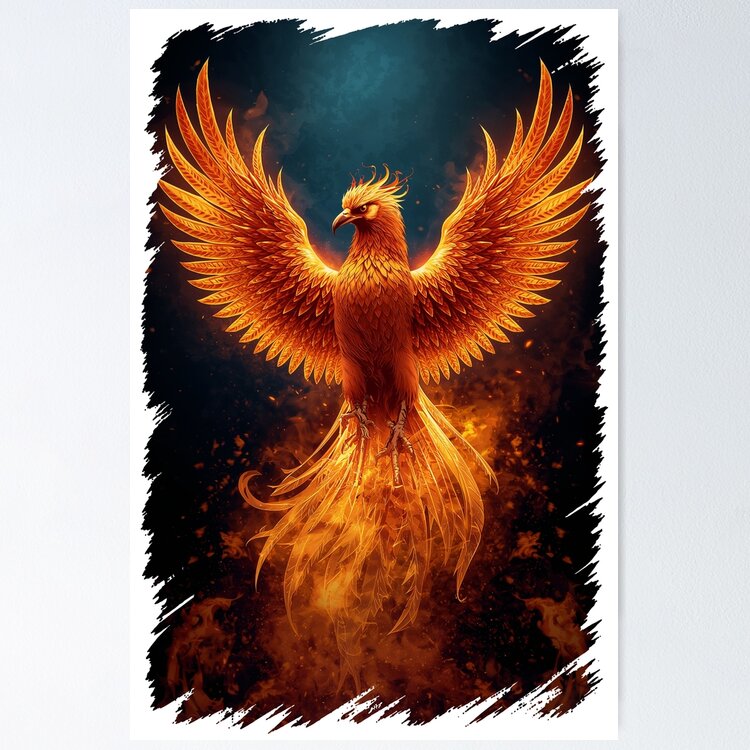
Love what you are seeing?
Every design in this story is printed on demand and shipped worldwide by Redbubble.
A gift of strength to carry
As a sticker on a laptop or binder, the message travels with the student into exam rooms and late-night study sessions — the exact moments resilience is tested hardest and adults are nowhere nearby. Teachers and parents often give these as small tokens of belief: a quiet way of saying I know you can handle this, kept close where the student will see it precisely when they need it most.
For a young person going through a hard season — a tough year academically, a loss at home, a confidence that has taken a beating — that small, repeated reminder can matter more than any single conversation. Conversations end; a sticker on the laptop they open every day does not. It keeps whispering the same steadying message long after the talk is over.
There is also real power in a student choosing to keep it. A creed someone hands you can be ignored, but a creed you decide to stick on your own laptop becomes something you have claimed for yourself. That sense of ownership is exactly what makes resilience feel like a choice rather than an instruction.
Shop the sticker →
When a single line is enough
There is a reason short, powerful lines outlast long speeches. In a moment of genuine discouragement, a student does not have the bandwidth for a paragraph of advice — but four words on a wall can slip past all the noise and land. I am the captain of my soul is exactly that kind of line: brief enough to remember under stress, deep enough to lean on.
Keep that in mind when you place the poster. The most powerful spot is wherever a student is most likely to feel like quitting — beside the hard work, near the test, in the corner where the difficult conversations happen. A single strong line, met at the right moment, can do what an hour of advice cannot: it can get a discouraged student to lift their head and try once more.
Put resilience on the wall
The words we give students for their hardest moments tend to stay with them for life. 'Invictus' has steadied people through genuine adversity for more than a century, and on a classroom or bedroom wall it keeps doing that work — one glance at a time, on the days it is needed most.
See it full-size and choose your format on Redbubble — poster, print or sticker — and explore the Inspiration collection for companion pieces like the Fiery Phoenix Rising to build a corner devoted to bouncing back. Give the students in your life a creed worth holding onto when everything in them wants to quit.
Shop the poster →Designs from this story
Tap any piece to view it, or buy it straight from Redbubble.


Keep exploring
More stories, more collections, more original art to make yours.